
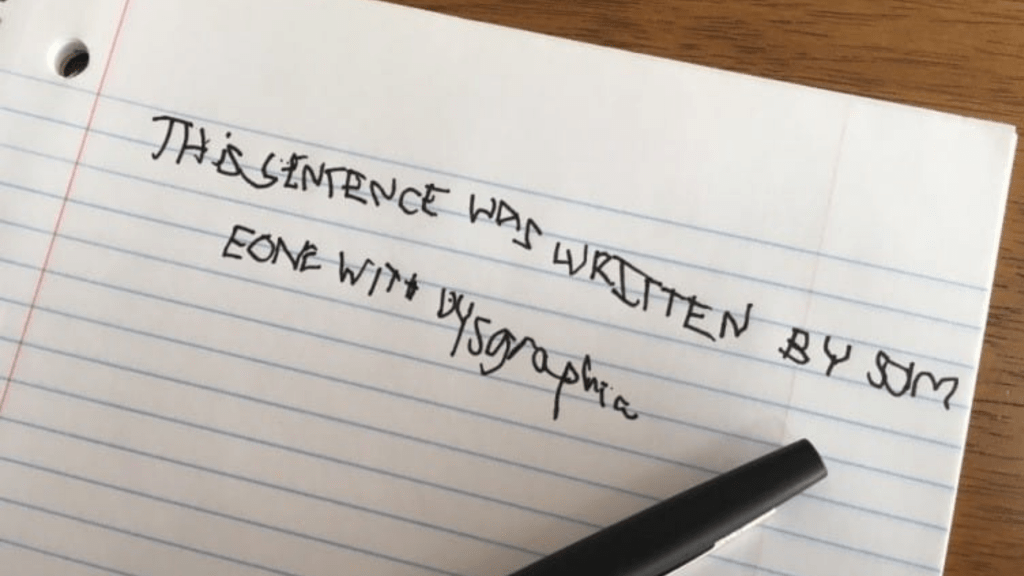
Grab a pen and a piece of paper. Now write your name with your non-dominant hand. What was that like? When explaining the importance of personality preferences, clients often say this task is difficult, awkward or strange, but not impossible. Being in a work environment that does not match your personality preferences is like that. When you work in an environment that does not support your natural way of being, you will never feel 100% comfortable.
Knowing your personality preferences helps you find work that allows you to thrive in environments where you can express your natural way of being. The Myers-Briggs Type Indicator® (MBTI) helps you identify these preferences.
If I already know what types of jobs I want, why do I need to know my personality preferences? In my blog post about Personal Branding I stated that it starts with knowing who you are. Having the vocabulary to describe your leadership, communication and work styles, enables you to articulate them in a resume, cover letter, interview, LinkedIn Profile, emails and any communication with your network. It is one more way to explain to hiring managers why you are a great fit for the job.
Who created the MBTI? According to the Myer-Briggs Foundation, the theory of psychological type was introduced in the 1920s by Carl G. Jung. The MBTI tool was developed in the 1940s by Isabel Briggs Myers and the original research was done in the 1940s and ’50s. Today it is used by counselors in career development, relationship counseling and team building.
How do I determine my personality type? When you take a career assessment or survey to determine your MBTI four-letter code, you are answering questions based on four dichotomies in the illustration below. When I work with clients, I explain each of the dichotomies and ask them to choose a preference based on the information they provide about their natural way of being. It’s about the actions and choices you make daily, without giving them much thought. In order to get an accurate interpretation of your personality preferences, I recommend meeting with a career counselor to verify your code.
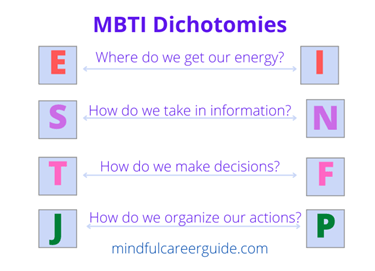
In the first dichotomy, extroverts (E) get their energy from the outside world and introverts (I) get their energy from their inner thoughts. In the second dichotomy sensors (S) see the world based on their five senses while intuitives (N) see possibilities based on imagination. In the third dichotomy, thinkers (T) make decisions based on facts and experience, while feelers (F) make decisions based on relationships and maintaining harmony. In the final dichotomy judgers (J) organize their actions by planning and scheduling, while perceivers (P) prefer to be spontaneous and like to keep their options open.
Truity.com has a free survey that helps individuals determine their personality type. The 16 types are listed in the graphic below. To ensure that the type suggested is accurate I always recommend that individuals read about their type and watch the videos on the web site. After verifying that the four letter type is the best match, I recommend reading the descriptions in the careers section and making a list of the phrases and words that resonate. As you read the descriptions ask yourself: Which words describe the environments in which I thrive?

How do I use the information? Because of the changing nature of our workplace, I don’t use personality types to generate a list of jobs that might be suitable for clients. These lists tend to limit the imagination and often don’t include jobs on the cutting edge of technology. I like to use this assessment to help clients generate a list of key words that describe themselves. These key words help clients evaluate opportunities and explain why specific work situations are a great fit.
In addition to using the words and phrases to communicate who you are, I recommend that clients use this language to search for jobs on web sites such as Indeed.com, Google Jobs or LinkedIn. Combining words that describe your personality with the skills you want to use could result in finding work environments where you feel most comfortable.
Taking these steps will help you avoid work opportunities where you have nothing in common with coworkers and are unable to express your unique communication, organization, work and leadership styles. Remember that hiring managers are not only looking for specific skills, they also seek individuals who are a great cultural fit for the team.
To learn more about how to use your personality type to get a great job, contact me at mindfulcareerguide.com for a free consultation.
 Mindful Career Guide