
I get so many questions about resumes, so I decided to take a deep dive and explain the different parts in detail. In Part 1 of the Resume Deep Dive, I am starting with the most important space on your resume – the top one-third of the page. This space is really important because the average hiring manager will look at your resume for six seconds. The person making decisions about who gets an interview receives 250 resumes on average. There is not a lot of time to read the entire resume and decide who is qualified for the job.
Use a readable font. When the person reading the resume has so little time to find the information they need, it is important to use a readable font. I recommend a font that does not have serifs, like Arial. Use a font that is no smaller than 11 points.
Use simple formatting. In addition to having a human read your resume, an application tracking system (ATS) might scan your resume. The scanner moves across the page from left to right. Using columns and graphics in the resume will cause the scanner to record words out of order and this will lower your qualifications score. The exception to this simple formatting rule is when you are applying for work in the entertainment or arts industries, where the resume needs to be visually appealing.
Do not waste space on your name. Your name should be in bold font no larger than the headings in the body of your resume. You want to provide the most space at the top of the page for your qualifications, so keep your name on one line.
The second line of your resume will contain your contact information including your phone number, email, city, state, and LinkedIn URL. If this does not all fit on one line, make the font smaller. The contact information will appear on the job application, so it is not as important as other content on the page that communicates your fit for the job.
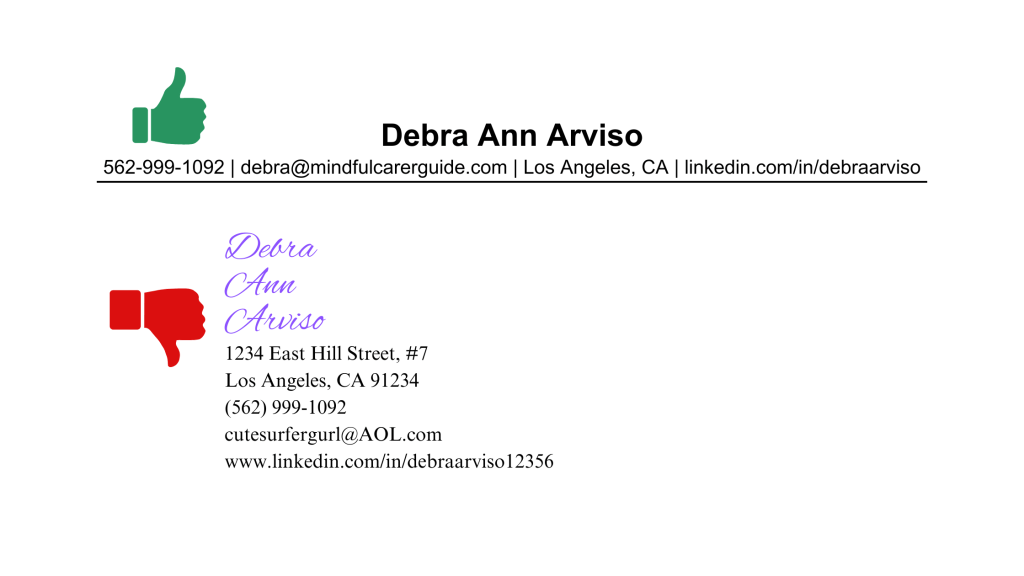
The phone number that is listed on your resume should only be answered by you. Make sure that the voice mail message is professional and that you check the voice mail every day. Your children might sound cute, but that doesn’t help you get a job. The message and tone must be consistent with your personal brand and your first impressions should convey professionalism. The way you communicate on the phone tells the potential employer how you might communicate in a work situation.
Use a professional email address. In addition to a professional voice mail message, use an email address that is simple and checked daily. I’ve seen cute nicknames, jokes, references to hobbies, partying and 420. Unless these references are consistent with your personal brand they don’t belong on a resume. Preferably, your email contains your first name and last with a domain name that is consistent with your brand. Do not make yourself seem out of touch with technology by using old email domains such as: AOL Mail, Hotmail, Lycos, Mail.com and Yahoo! Mail. Get a free Gmail account if you are using an old domain.
Do not include your mailing address. There are creeps out there, so only include your city and state to protect your personal safety. Your resume might be seen by more than ten people at an organization, so you don’t want everyone to know where you live. Most of the time you will include your mailing address in an online application that is only seen by human resources professionals and is stored in a secure ATS database. To keep yourself safe, do not provide personal information about where you live on your resume.
Shorten your LinkedIn URL. Your LinkedIn URL should appear at the end of your contact information because 87% of recruiters find LinkedIn the most effective platform for vetting job candidates (Jobvite 2023). They will look at your profile to determine whether or not they should invite you for an interview. If this does not appear on your resume, the employer might be concerned that you do not have a LinkedIn profile and therefore are not knowledgeable about basic office technology. The first thing you need to do before you send that resume, is to update your profile and URL. Posting content and commenting on other’s content also shows a potential employer that you are active on the platform.
Whew! That’s a lot of detailed information about the first two lines of your resume. In Part 2 of the Resume Deep Dive, I will explain how to write the highlights of qualifications section. If you would like help with writing your resume or job search strategies, set up a free consultation.
 Mindful Career Guide