
The average hiring manager spends six seconds reading each resume because they are receiving 250 job applications when a position is advertised. That is not a lot of time to convince them that you are the perfect person for the job. Using key words and formatting strategically will help the reader quickly determine if you deserve a job interview. The most important information must appear at the top 1/3 of the page. In Part 2 of my Resume Deep Dive, I will help you communicate that you are the perfect person for the job by listing your highlights of qualifications at the top of the page. This section contains five bullet points that succinctly describe what the employer most wants and how your experience matches that wish list.
Start by identifying key words. I think of resume writing as a game. The object of the game is to get as many key words and phrases from the job description on your resume as possible, without lying. Your first task is to read the job description and highlight key words and phrases. It is important to use the hiring managers language because those are the words that are in their head as they try to quickly determine if you are qualified for the job.
Determine what the employer needs most. After you have highlighted the key words and phrases that need to be on your resume, decide which five skills or attributes are most important to the employer. There are a few clues that are helpful on a job description including:
- Qualifications section
- Requirements section
- Position summary paragraph at the top of the job description
- Skills that are repeated in the job description
- Skills that appear at the top of the job description
- Skills that appear at the top of the list of job responsibilities
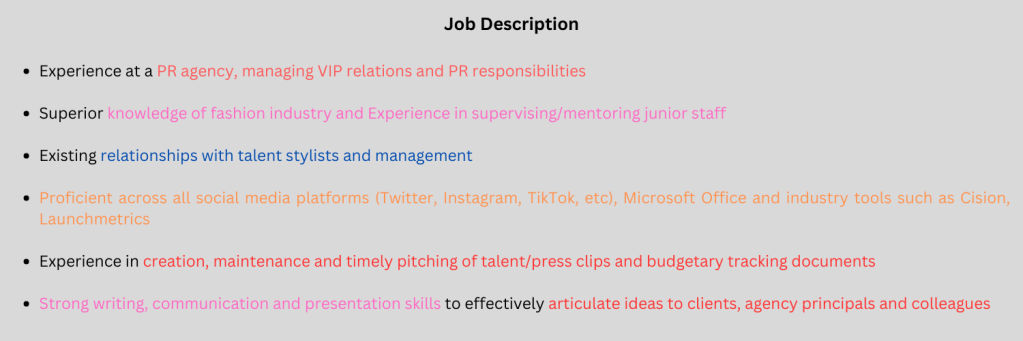
Copy and paste the key words onto your page. I recommend that you copy and paste the entire phrase onto the page. Often you can get more than five skills to fit into five bullet points, but you want to at least list the top five skills from the job description. In the example above, I highlighted key words from a job description for a public relations position. I pasted a few phrases from the qualifications section onto the resume.
At this point, many clients ask me if copying key phrases from the job description is plagiarism or a practice that will seem strange to an employer. Using the exact words from the job description helps the employer determine if you have the experience they need – in six seconds.
Match your experience to the key words. You will need to take an inventory of your employment history to determine if you have paid or unpaid work experience that matches the bullet points from the job description. Be honest about your experience and assume that the hiring manager will ask you about everything on the resume during an interview. In the example below the applicant had most of the experience listed in the bullet points, but they did not have formal supervisory experience and lacked the knowledge needed to use some of the software listed. These skills will not be listed on the resume.
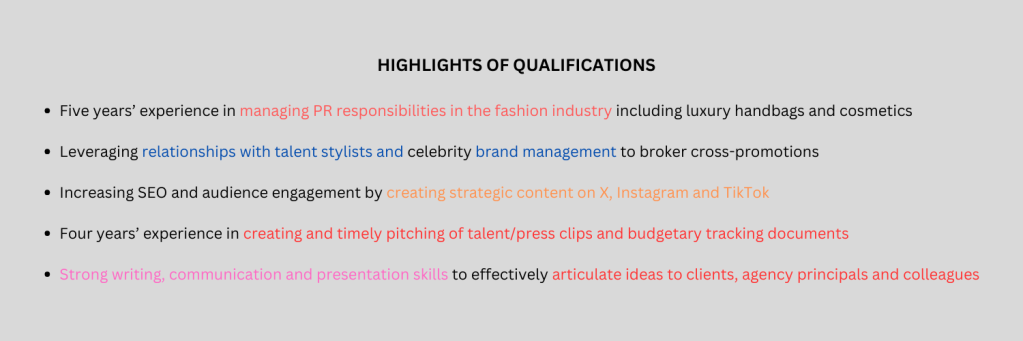
Add context to each bullet point. After you have narrowed your list of skills to match your experience, tell the reader how you used each skill. Add details about the industry in which you used the skill or the population you served. Add details about your proficiency and how many years you have been using the skill. Try to quantify your experience as much as possible. For example, state how much money you saved or managed, how many people you supervised or how many projects you completed each year. In the example below, the applicant is able to tell the reader how many years of experience they have in public relations, what type of products they promoted and what specific tasks they managed on social media platforms.
Be mindful of formatting. Once you have five bullet points to list under your Highlights of Qualifications Section of your resume, make sure that each bullet point fits on one line. It takes more time to for the hiring manager to read beyond one line of text, so you might need to change a long bullet point into two bullet points. Doing an online search for synonyms and enlisting the help of a friend to edit your text will allow you to tell your story in fewer words.
Congratulations for reading the first two parts of my Resume Deep Dive! You now have the knowledge you need to fill the top 1/3 of the page with information that will result in an interview. In part three of this series you will learn how to format the body of your resume and showcase your relevant work experience. If you need help telling your unique career story in a resume, cover letter or interview, schedule a free consultation with me.
 Mindful Career Guide